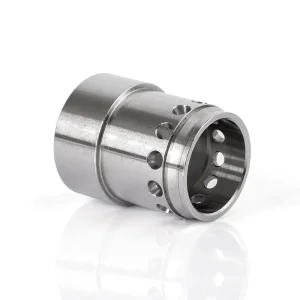
Precision Engineering Portfolio
Engineered Casting & CNC Production Gallery
Explore our custom manufactured industrial castings, precision assemblies, and post-machined components engineered to withstand extreme thermal, fluidic, and mechanical stresses.
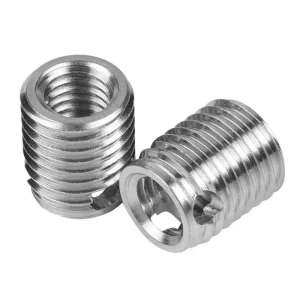
Fastening Systems
Custom Custom Self-Tapping Threaded Inserts Product, Exporters
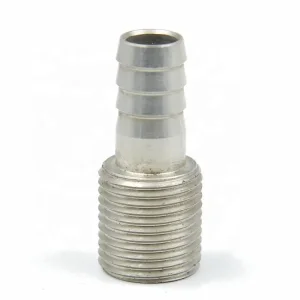
Hydraulics & Pneumatics
OEM Custom CNC Turned Hose Barb Fittings & Threaded Adapters Manufacturer, Factory
Industry Strategic Intelligence
Global Macro Trends & Commercial Realities in Metal Casting
As global industrial electrification, automation, and aerospace engineering demand near-net-shape components with elevated metallurgical integrity, structural casting operations face revolutionary transitions.
EV Powertrain Lightweighting
The global commercial vehicle and automotive sectors require massive transition from multi-component sheet fabrications to monolithic, high-pressure die cast (HPDC) and vacuum-assist aluminum components. Achieving structural wall thicknesses under 2.0 mm while maintaining impact yield strengths above 180 MPa has revolutionized casting chemistry.
Thin-wall Al-Si-Mg Alloys
Giga-Casting Scalability
Industrial casting has transitioned from small bracketry to integrated megacasting units weighing upwards of 80 kg. This architectural shift significantly cuts down sub-assembly robotics, fastener costs, and dimensional accumulation variances across modern robotic automated production lines.
Reduced BOM Complexity
High-Integrity Investment Casting
In oil, gas, aerospace, and chemical processing, precision silica sol lost-wax investment casting represents the golden standard for nickel-chromium superalloys, CF8M, and duplex stainless steels, delivering corrosion resilience and high tensile endurance without micro-void leakage.
Zero Internal Porosity
Sustainability & Closed Loops
Global carbon audits (CBAM) enforce strict energy metrics on foundries. Modern Chinese foundry ecosystems utilize secondary recycled aluminum ingots, electric induction melting systems, and waste-sand reclamation loops that minimize embodied lifecycle carbon by over 38% compared to blast-furnace operations.
Low-Carbon Foundry Footprint
Industrial Competitiveness
The Engineering Velocity & Ecosystem Advantage of China
Why international procurement executives consistently choose Chinese casting facilities: A synergistic balance of rapid tooling design, ultra-deep upstream material access, and seamless in-house multi-axis machining.
Rapid Tooling Velocity
While Western tooling lead times often range between 16 to 24 weeks for complex multi-cavity slide molds, our Greater Bay Area tooling centers design, simulate (AnyCasting / MAGMASoft), machine with high-speed CNC EDM, and deliver T1 sample castings in as brief as 18 to 28 business days.
Closed-Loop Integration
Many third-party casting exporters ship raw rough castings requiring post-processing overseas. We integrate vacuum die casting, deburring, heat treatments (T5, T6, solution annealing), 5-axis CNC machining, ultrasonic cleaning, and automated powder coating/anodizing within a singular, audited corporate supply pipeline.
Deep Raw Material Matrix
Direct mill relationships ensure immediate access to certified chemical grade ingots: A380, ADC12, A356, ductile iron (QT450, QT500), grey iron (HT200, HT250), 304/316/316L stainless, 17-4PH, and specialized bronze alloys, paired with spectrographic melt validation reports.
Engineering Verification & Process Control
Micro-Precision Standards & Defect Zero Verification
Every cast geometry undergoes finite element thermal simulation, vacuum venting optimization, and sub-micron CMM validation before release.
±0.005mm
Critical CNC Feature Tolerance
<0.05%
Gas Porosity via Vacuum Die Casting
5,000t/yr
Combined Casting & Stamping Output
100%
In-House FAI, Spectro & CMM Inspection
| Casting Methodology | Common Materials | Linear As-Cast Tolerance | Surface Roughness (Ra) | Ideal Production Batch |
|---|---|---|---|---|
| High-Pressure Die Casting (HPDC) | Aluminum (A380, ADC12), Zinc (Zamak 3, 5) | ±0.10 mm to ±0.25 mm | 0.8 – 1.6 μm | High Volume (5,000 – 1,000,000+ pcs) |
| Precision Investment Casting (Lost Wax) | Stainless Steels (304, 316, 17-4PH), Alloy Steel | ±0.15 mm to ±0.30 mm | 1.6 – 3.2 μm | Medium to High (500 – 50,000 pcs) |
| Gravity Die Casting (Permanent Mold) | A356, AlSi7Mg0.3 (T6 Heat Treated) | ±0.20 mm to ±0.40 mm | 3.2 – 6.3 μm | Medium (1,000 – 20,000 pcs) |
| Resin Sand Casting | Ductile Iron (QT500), Grey Iron (HT250), Cast Steel | ±0.50 mm to ±1.50 mm | 6.3 – 12.5 μm | Low to Medium (50 – 5,000 pcs) |
| CNC Finish Machining (Post-Casting) | All Cast Ferrous & Non-Ferrous Metals | Down to ±0.005 mm | 0.4 – 0.8 μm | From 1 pc (Proto) to Mass Production |
Application Versatility
Mission-Critical Deployment Scenarios
How our industrial casting and precision finish-machined components operate under severe mechanical environments across global industrial landscapes.
Automotive & Commercial Fleet
Structural steering knuckles, suspension control arms, battery management system (BMS) liquid cooling enclosures, turbocharger impellers, and transmission valve bodies requiring vacuum die cast integrity and 100% helium pressure leakage testing.
Industrial Robotics & AGV Systems
Multi-axis articulated robot arm links, cast aluminum cycloidal reducer housings, robotic end-of-arm tooling (EOAT) mounting rings, and motor stator frames where lightweight strength directly dictates dynamic acceleration and positional accuracy.
Fluid Dynamics, Pumps & Valves
Investment cast CF8M stainless flow control bodies, high-pressure hydraulic manifold blocks, drilled filter sleeves, and chemical pump impellers engineered to endure cavitation wear, corrosive chlorides, and cryogenic or superheated fluid flow.
Renewable Energy & Power Inverters
Solar microinverter finned heat sinks, wind turbine yaw bearing housings, high-conductivity flexible busbar structural clamps, and power grid transformer junction shells built with environmental salt-spray corrosion protection.
Sourcing Excellence
Global OEM Procurement Architecture: De-Risking Your Pipeline
How Fortune 500 equipment builders and European Tier-1 procurement teams evaluate, qualify, and stabilize long-term casting partnerships in China.
PPAP Level 3 Documentation
We satisfy strict automotive and industrial sourcing gates by providing comprehensive Production Part Approval Process (PPAP Level 3) packages, including Process FMEA, Control Plans, Gage R&R studies, full 24-piece ballooned CMM inspection layouts, and material mill certs.
NDT & Structural Non-Destructive Testing
Defect elimination relies on industrial X-ray computed tomography (CT scanning) to detect internal gas bubbles or shrinkage voids, hydrostatic/helium sniff testing for hermeticity, magnetic particle inspection (MPI), and dye penetrant testing (PT) on critical fillet radii.
Direct Engineering Communication & IP Protection
Working directly with bilingual mechanical tooling engineers eradicates middleman distortion. Non-Disclosure Agreements (NDAs) are signed under international jurisdiction before CAD transmission, ensuring proprietary IP protection throughout tooling lifecycle management.
Technical Clarifications
Engineering & Procurement FAQ
Clear, unequivocal answers regarding dimensional tolerances, metallurgical integrity, mold maintenance, and international export logistics.
What linear tolerances can be maintained across raw casting versus post-CNC machining?
As-cast raw tolerances conform to ISO 8062 (CT4 to CT6 for aluminum high-pressure die casting; CT5 to CT7 for precision investment casting). For critical bearing journals, sealing faces, and dowel locating holes, our temperature-controlled 4-axis and 5-axis CNC machining centers hold positional and dimensional tolerances down to ±0.005 mm (±0.0002 in) with surface finishes reaching Ra 0.4 μm.
How does Sunmy Hardware eliminate internal gas porosity in aluminum die casting?
We apply multi-stage melt degassing using dry argon or nitrogen, paired with vacuum-assisted die casting chill vents that pull cavity pressure below 50 mbar prior to molten metal injection. Additionally, our tooling design engineers simulate shot sleeve plunger velocity profiles using AnyCasting software to avoid turbulent air entrapment during high-speed intensification.
What is the standard tooling lifespan guarantee for high-pressure die casting molds?
Tooling fabricated from premium imported H13, Dievar, or Böhler W300 tool steel with vacuum quenching and multi-step nitriding carries a guaranteed life of 100,000 to 150,000 shots for aluminum, and up to 500,000 to 1,000,000 shots for zinc alloys. Mold maintenance, refurbishment, and cavity insert replacements are handled completely in-house at zero additional cost over the agreed production program.
Which documentation is delivered alongside volume production shipments?
Every shipment arrives with a complete Quality Assurance Dossier containing: (1) Raw Material Spectrographic Chemical Analysis Certificate, (2) Tensile and Hardness Mechanical Test Data, (3) Zeiss CMM Full Dimensional Layout Report, (4) First Article Inspection (FAI) Form, (5) RoHS / REACH Compliance Declaration, and (6) Salt-Spray / Anodizing / Coating Thickness Validation Certificates where required.
Can Sunmy Hardware transition prototypes directly into high-volume serial tooling?
Yes. We regularly support rapid functional prototyping through 5-axis billet CNC machining, 3D metal printing (SLM), or soft-tooling polyurethane casting to validate mechanical kinematics. Once product geometry is finalized, our engineers design production-hardened progressive die tooling, gravity permanent molds, or high-pressure die casting dies without design translation disconnects.
Sub-Assembly & High-Tolerance Parts
Specialized Casting & Multi-Process Component Export
Precision cast and CNC finished parts engineered for advanced robotics, electrical power distribution, optoelectronics, and unmanned aerospace applications.
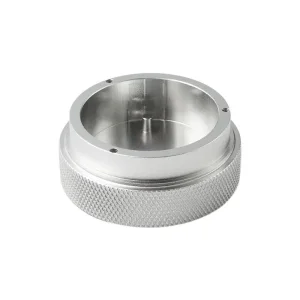
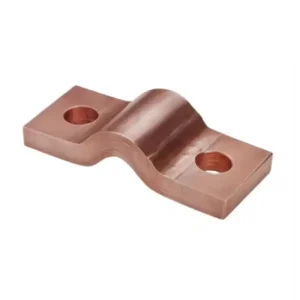
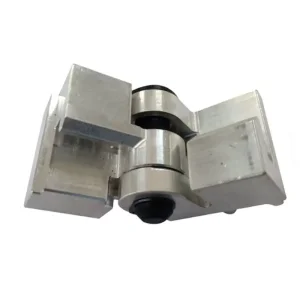
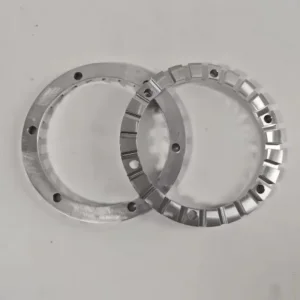
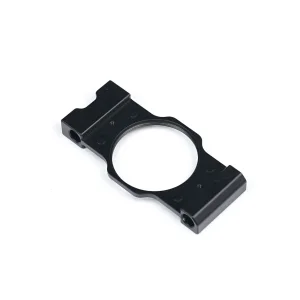
Optomechanical Brackets
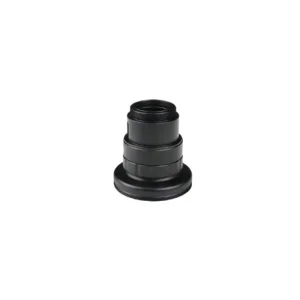
OEM Custom CNC Machined Aluminum Optical Lens Mounting Bracket (Matte Black) Service, Products