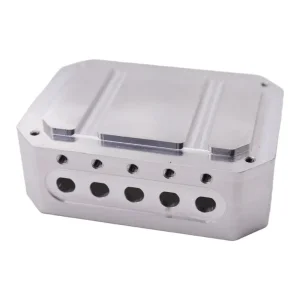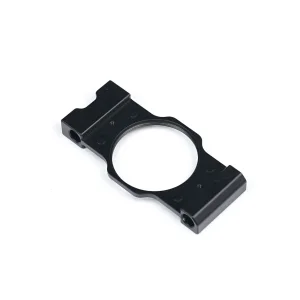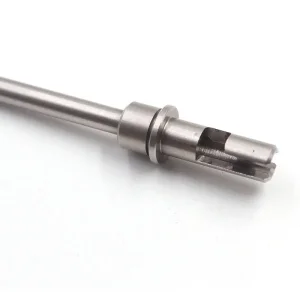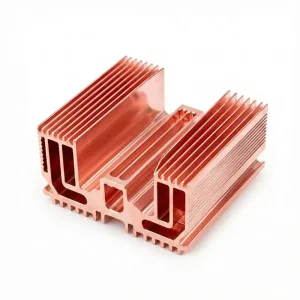
Engineered Assemblies & Mechanical Components
Explore custom components manufactured to drawing specifications with full material traceability, coordinate measuring machine (CMM) inspection, and certified mechanical tolerances.
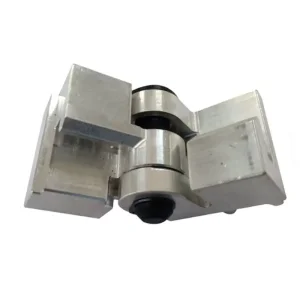
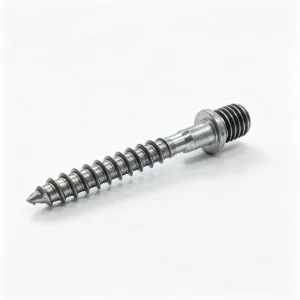
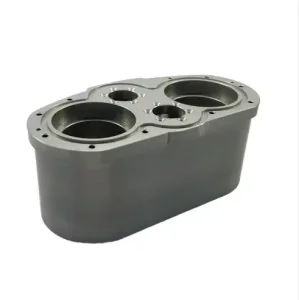
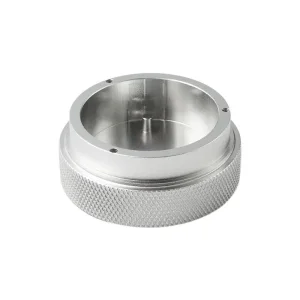
Global Industrial Landscape of Precision Machined Enclosures
In modern high-frequency electronics, defense avionics, edge computing, and medical instruments, metal enclosures have evolved from basic protective boxes into complex functional sub-systems governing thermal dissipation, electromagnetic compatibility (EMC), and environmental hermetic sealing.
EMI/RFI Shielding Integrity
Unlike folded sheet metal or die-cast boxes with porosity flaws, billet CNC-machined enclosures provide continuous crystal structures and uninterrupted conductive surfaces, securing isolation attenuation levels above 80 dB in high-frequency microwave and millimeter-wave radar applications.
Conducted Thermal Dissipation
High-power silicon, such as AI acceleration chips and RF power amplifiers, demands direct thermal conduction paths. CNC machining allows the integration of micro-channel liquid cold plates, custom fin profiles, and raised thermal pads directly into the chassis monoblock.
IP67/IP68 Hermetic Sealing
Aerospace and marine applications demand continuous O-ring grooves and knife-edge seal profiles held within ±0.01 mm of coplanarity. Machined billet enclosures avoid the micro-cracking and gas inclusion risks inherent in high-pressure casting.
Shenzhen Precision Ecosystem: The Agility Benchmark
Shenzhen Sunmy Hardware Co., Ltd. sits at the heart of the world’s most integrated industrial supply chain in the Greater Bay Area, translating customer CAD models into production reality with accelerated turnaround times and uncompromising quality control.
Rapid Prototype-to-Scale Bridge
Engineering teams bridge the gap between initial single-cavity prototype validation and high-volume multi-pallet production. We transition components smoothly from 5-axis CNC machining into die casting, stamping, or injection molding under one roof.
Localized Surface Finishing Network
Within a 30-minute radius of our Longgang machining center, audited partner facilities support specialized Mil-Spec Class III hardcoat anodizing, chemical film conversion (chromate MIL-DTL-5541), nickel electroplating, and automated powder coating.
Zero-Intermediary Direct Communication
Clients interface directly with bilingual manufacturing engineers. Every design for manufacturability (DFM) check addresses draft angles, tool access, and wall thicknesses directly, avoiding misunderstandings caused by third-party trading agencies.
Critical Applications & Technical Engineering Matrix
Custom machined enclosures serve as structural skeletons and protective barriers across high-reliability operating environments.
| Application Sector | Primary Material Alloys | Critical Tolerances & GD&T | Surface Treatment & In-House Verification |
|---|---|---|---|
| RF & Microwave Radar Housings | Aluminum 6061-T6, AL 7075-T651, Brass C3604 | Cavity depth ±0.01 mm, Step Coplanarity 0.008 mm | SurTec 650 / MIL-DTL-5541 Chem-Film, Silver Plating, Vector Network Analysis |
| Autonomous Robotics & LiDAR Shells | AL 6082, Magnesium AZ91D, Polycarbonate (Optical) | True Position <0.012 mm, Perpendicularity 0.01 mm | Type II Anodizing (Matte Black), Thread Helicoil Inserts, CMM 3D Scanning |
| Subsea Instrumentation & Sensor Probes | AISI 316L Stainless Steel, Titanium Gr 5 (Ti-6Al-4V) | Bore Cylindricity ±0.005 mm, Thread Class 3A/3B | Electropolishing, Passivation ASTM A967, Hydrostatic Pressure Proof Testing |
| Semiconductor Handling & Wafer Carriers | High Purity Billet Aluminum, PEEK, POM-C (Delrin) | Surface Flatness <0.02 mm over 400 mm length | Hard Anodize Type III (50µm), Class 100 Cleanroom Packaging, Particle Inspection |
Emerging Trends in Global Enclosure Procurement
Procurement directors and sourcing executives in Europe, North America, and Japan face evolving design requirements that shift how precision enclosures are evaluated and acquired.
Demand for Monolithic Topology
Engineers are replacing multi-piece sheet metal assemblies with monolithic 5-axis machined frames. This eliminates welded seams, guarantees absolute sealing surfaces, and cuts assembly labour costs on OEM integration lines.
Full Inspection Traceability
Global supply chains now require raw material mill test certificates (MTC 3.1) and complete AS9102-style First Article Inspection (FAI) reports with bubble drawings tied directly to in-house Zeiss CMM coordinate data.
High Mix, Variable Batch Agility
Accelerating product iterations require suppliers that move fluidly between 10-piece pilot builds and 5,000-piece serial runs without burdensome tooling setup amortizations or months-long queue times.
Stringent IP & Drawing Protection
With proprietary internal cavity geometries representing valuable IP, enterprise buyers require comprehensive, enforceable NDAs executed prior to exchanging native STEP or CAD models directly with the production team.
Technical & Procurement FAQ for Custom Enclosures
Review engineering tolerances, testing practices, material grades, and logistical protocols with our technical team.
What geometric tolerances can Sunmy achieve on complex milled enclosures?
Which enclosure materials are recommended for thermal conductivity versus weight reduction?
How do you ensure proper EMI/RFI shielding and IP-rated environmental sealing?
What quality assurance documentation accompanies export shipments?
How are customer CAD models and intellectual property safeguarded?
What is your turnaround timeframe for DFM feedback and quotation delivery?
Specialized CNC Enclosures & Mechanical Solutions
Explore our precision-machined brackets, chassis assemblies, custom enclosures, and thermal management components designed for complex assemblies.