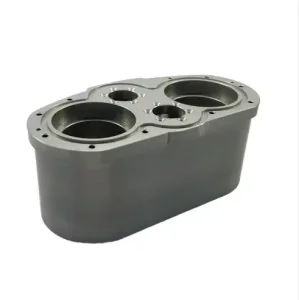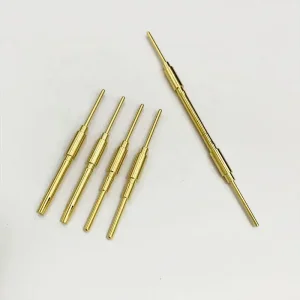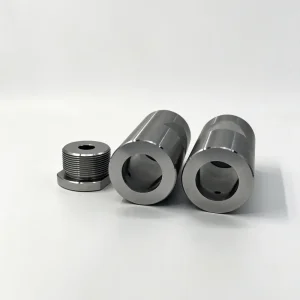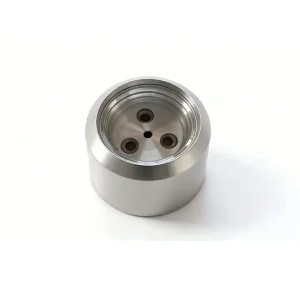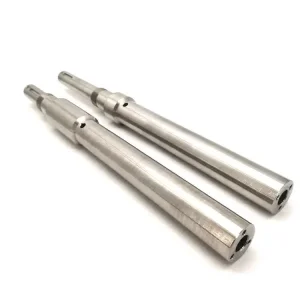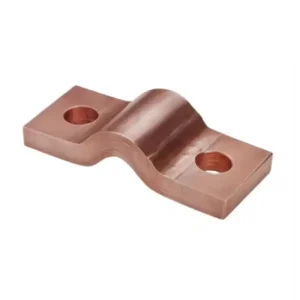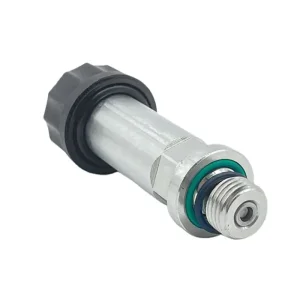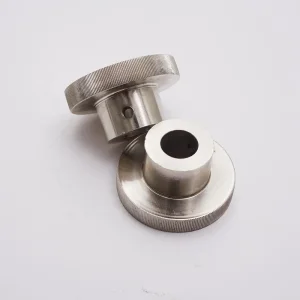
Featured Thermal & Mechanical Precision Components
Explore engineering deliverables built to strict GD&T specifications, utilizing Swiss-turning and multi-axis machining capabilities directly from our Shenzhen facility.
The Global State of Heat Sink Machining: The Thermal Bottleneck Crisis
Why modern power densities demand radical shifts from standard extrusions to high-precision CNC multi-axis subtractive milling.
The contemporary electronics ecosystem is traversing a decisive structural transition. Across high-performance computing (HPC), artificial intelligence hyperscalers, automotive inverter drive units, and localized power modules, silicon-level thermal design power (TDP) thresholds have outpaced the thermodynamic efficacy of conventional manufacturing processes. Historically, forced-convection cooling relied squarely upon extruded aluminum profiles, basic die-casting, or stamped bonded fins. Today, thermal engineers encounter power densities scaling beyond 100 W/cm² to 350 W/cm².
At these elevated heat flux gradients, conventional extrusion falls short due to strict mechanical limits: extrusion aspect ratios rarely exceed 15:1 to 20:1 without fin deflection, and inherent draft angles reduce active contact surface area. Standard die casting exhibits internal gas porosity, producing micro-void thermal barriers that cripple bulk thermal conductivity. Consequently, precision CNC heat sink machining has evolved from a rapid prototyping stopgap into a baseline volume-production process for mission-critical assemblies.
AI Data Centers & Supercomputing
Accelerators exceeding 800W TDP require micro-channel liquid cold plates and precision-milled copper/aluminum hybrid heat sinks where base flatness tolerances within 0.01mm minimize thermal interface resistance (TIM).
Automotive Electrification (xEV)
Silicon Carbide (SiC) and Gallium Nitride (GaN) onboard traction inverters generate acute thermal concentrations requiring 5-axis pin-fin turbulator arrays directly machined into fluid passages.
RF & Telecommunication Radars
Millimeter-wave 5G massive MIMO arrays and active phased-array aerospace antennas combine thermal conduction with electromagnetic shielding (EMI), mandating integrated thin-walled chassis.
Chinese Factory Efficiency & Supply-Chain Ecosystem Advantages
Deconstructing the technical, structural, and tooling speed levers that position Shenzhen and the Pearl River Delta as global manufacturing benchmarks.
When global hardware brands shift production from domestic facilities or tier-one Western contract hubs to Sunmy Hardware in Shenzhen, the primary performance upside stems from physical supply-chain cohesion rather than labor arbitrage. Within a 30-kilometer radius in the Pearl River Delta manufacturing corridor, our operations synchronize pure oxygen-free copper (C10100/C11000) drawing mills, specialized aluminum vacuum die casting, custom extruders, and surface treatment facilities specializing in Mil-Spec hard anodizing and electroless nickel immersion.
Aggressive Tooling & Prototyping
By leveraging dedicated high-speed gantry CNC machines running up to 30,000 RPM spindles, we collapse multi-cavity DFM iterations from the Western industry standard of 6–8 weeks down to 5–7 operational days.
Hybrid Process Synthesis
We blend multiple thermal methodologies under one roof: skived-fin copper bases friction-stir welded (FSW) onto liquid-cooled CNC housings, combined with vacuum-brazed vapor chamber assemblies.
Direct-to-Factory Accountability
We completely eradicate intermediary commercial trading friction. Clients communicate directly with manufacturing and thermal engineers, verifying coordinate measuring machine (CMM) data sets prior to packing.
| Thermal Machining Dimension | Conventional Western Hubs | Standard Commodity Exporter | Sunmy Hardware Shenzhen Plant |
|---|---|---|---|
| Micro-Fin Aspect Ratio | 15:1 to 20:1 max | 12:1 | Up to 45:1 (via Skiving + 5-Axis Milling) |
| Mounting Base Flatness | 0.05 mm standard | 0.1 mm | ≤ 0.005 mm (Verified via Zeiss CMM) |
| Surface Roughness (Ra) | Ra 0.8 μm | Ra 1.6 μm | Ra 0.2 – 0.4 μm (Mirror fly-cutting) |
| Prototyping Lead Times | 5 to 7 Weeks | 3 to 4 Weeks | 3 to 5 Days (Including FAI Documentation) |
Materials, Manufacturing Tolerances, and Finishing Methodologies
A comprehensive engineering breakdown of heat dissipation alloys and surface functionalization available in-house.
Selecting the optimal balance of material conductivity, density, and machinability dictates the thermal efficiency and mechanical resilience of your end-assembly. Aluminum 6061 provides solid machinability and structural strength, whereas Aluminum 6063 provides superior bulk thermal conductivity for extruded and finish-machined geometries. For extreme dissipation requirements, Oxygen-Free Electronic Copper (C10100) eliminates internal micro-scale boundary resistances.
Alloy C10100 / C11000
Thermal conductivity: ~390-400 W/m·K. Unmatched performance for high-flux heat slugs, CPU vapor chamber contact plates, and high-amperage busbars.
Alloy 6063-T6
Thermal conductivity: ~201-218 W/m·K. Optimized for fine-detail CNC slotting, skived arrays, and high-efficiency thermal conduction chassis.
Alloy 6061-T6
Thermal conductivity: ~152-167 W/m·K. The engineering baseline for structural heat spreaders, ruggedized robotic shells, and automotive enclosures.
Metal-Matrix Composites
AlSiC (Aluminum Silicon Carbide) tailored for aerospace thermal applications requiring matching thermal expansion (CTE) with fragile direct bonded copper (DBC) ceramics.
Industry Trajectories: Liquid Cooling, Vapor Chambers & Additive Hybrids
The operational trajectory of heat sink engineering through 2026 and beyond.
Direct-to-Chip Liquid Cooling
Air-cooled racks are reaching thermal limits at 40kW per cabinet. Data centers are re-engineering around direct-to-chip microfluidic cold plates requiring precision CNC-milled serpentine microchannels under 0.15mm wall thickness.
Two-Phase 3D Vapor Chambers
Flat heat pipes are evolving into fully structural 3D vapor chambers, requiring precision CNC outer shells able to withstand high vacuum thresholds and continuous thermodynamic cycling without delaminating.
DMLS Additive & Subtractive Hybrids
Direct Metal Laser Sintering creates internal conformal lattice paths, followed by multi-axis CNC surface milling to achieve Ra 0.4μm interface lands and tight-tolerance O-ring seal grooves.
Global Sourcing & Quality Engineering Criteria
Checklist for Supplier Quality Engineers (SQEs) and procurement leads qualifying Chinese machining factories.
1. Metrology & Verification Rigor
Inspect factory-owned Coordinate Measuring Machine (CMM) capacity, laser surface profilometry, and optical imaging comparators. Sunmy executes complete First Article Inspection (FAI) reports mapped directly to your 2D GD&T drawings.
2. Material Traceability & RoHS
Demand documented mill test certificates with every batch. We provide spectral chemical breakdown reports confirming that high-conductivity alloys are free of adulterants and fully RoHS/REACH compliant.
3. IP & CAD Data Protections
Enforce strict, bilaterally executed NDAs prior to STEP file exchange. Direct communication with our Shenzhen technical personnel removes non-disclosure risks associated with unvetted broker networks.
Heat Sink Machining & Procurement Q&A
Technical and commercial answers addressing common engineering inquiries from global hardware teams.
What geometric tolerances can Sunmy achieve on thermal contact surfaces?
How does CNC machining compare economically to aluminum extrusion for volume production?
Can Sunmy combine multiple thermal manufacturing processes in one build?
How do you ensure galvanic corrosion prevention on mixed copper-aluminum heat sinks?
What export documentation and quality records accompany overseas shipments?
Structural, Electrical & Mechanical Assemblies
Explore our extended production run of CNC turn-mill, electrical busbar, and precision robotics components.